






Ford and Lincoln China Official Website
A visual editing-based content management platform for automotive brand official websites

Case Introduction
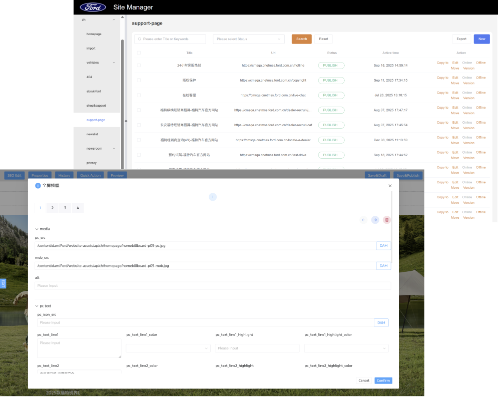
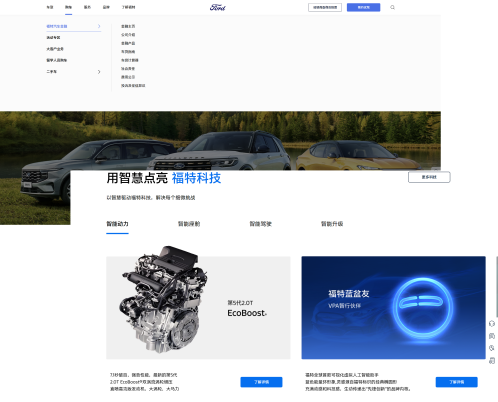
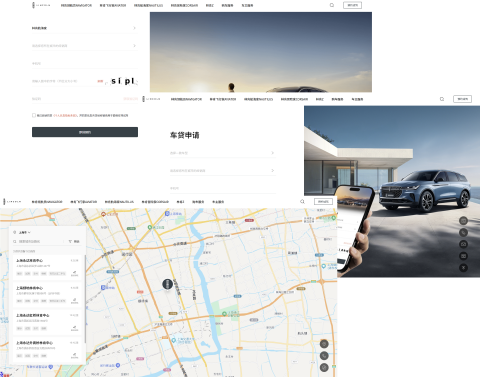
Ford China & Lincoln official website is built upon the enterprise-level technology foundation of DragonArch and the business architecture capabilities of the BMS digital experience platform. It provides componentized UI, visual building, fast publishing, and a unified media library. Supporting visual JSON Fragment editing, it enables structured content and multi-platform delivery. With responsive design, SEO, and standard API integration, it offers end-to-end digital support for content, interaction, and data analytics.
Pain Points


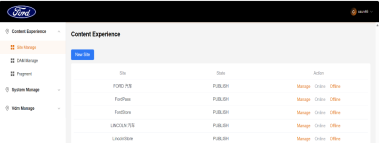
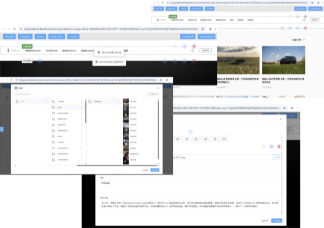
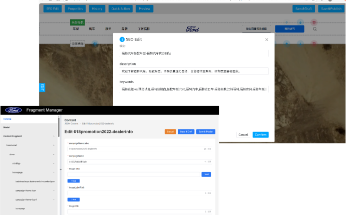
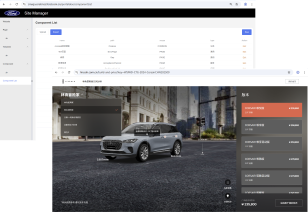



Case Page Showcase

Project Value

Agile and efficient digital content operations capability
Marketing and operations teams can independently build pages and update content through a visual interface, significantly shortening the cycle from planning to launch. A unified component library ensures consistency in brand visuals and user experience.

Maximization of content asset value
Through structured content management and a professional media library, brand content is transformed into manageable and searchable strategic assets, laying a data foundation for future personalized recommendations and precision marketing.

Building a future-ready digital foundation
A flexible technical architecture not only supports current business needs but also provides reliable technical assurance for the brand's future digital innovation.
Ford and Lincoln China Official Website Digital Transformation Case Study: Comprehensive Evolution from Traditional Models to BMS DXP
As a globally leading automobile manufacturer, Ford—and its luxury brand Lincoln—faced numerous challenges stemming from traditional content management approaches during their digital transformation in the Chinese market. To build a more agile, efficient, and unified digital experience, Ford and Lincoln China jointly opted for a comprehensive digital reconstruction and upgrade based on the Longfu Development Foundation (DragonArch) and the BMS Digital Experience Platform (BMS DXP). This article provides an in-depth analysis of this digital evolution, exploring architectural changes, core value propositions, and parity advantages associated with migrating from traditional models (e.g., Adobe AEM) to BMS DXP.
For enterprises previously reliant on large-scale traditional CMS systems such as Adobe AEM, migration to BMS DXP represents far more than a simple tool replacement—it signifies a holistic architectural evolution toward cloud-native, agile paradigms. Leveraging BMS DXP’s Content Management System (CMS) and Digital Asset Management (DAM) capabilities, the following outlines a typical migration pathway and architectural transformation analysis.
I. Migration Steps Breakdown
Migrating from traditional systems like Adobe AEM to BMS DXP typically follows a structured, phased implementation strategy:
Phase One: Asset and Content Inventory & Assessment. Conduct a comprehensive inventory of all digital assets (images, videos, documents, etc.) and structured content (pages, components, fragments) within the existing AEM system. Assess the reusability value of content and formulate cleaning and restructuring strategies.
Phase Two: Underlying Architecture and Environment Deployment. Build foundational infrastructure leveraging BMS DXP’s cloud-native, containerized architecture. Supports cross-cloud deployment across Alibaba Cloud, Tencent Cloud, AWS, and others—ensuring system flexibility and high availability.
Phase Three: Seamless Data and Asset Migration. Utilize BMS DXP’s external system integration capabilities to securely and efficiently migrate massive AEM media libraries and content data into the BMS system. BMS’s DAM module supports multi-cloud asset storage and centralized management, guaranteeing data integrity throughout migration.
Phase Four: Component Restructuring and Template Mapping. Map custom components originally developed in AEM to BMS DXP’s standardized component library. BMS offers a rich set of customizable components and templates, supporting on-demand composition and flexible configuration. For specialized business requirements, agile custom development is enabled via the Longfu Development Foundation.
Phase Five: Multi-Site and Unified Permission Configuration. Address Ford and Lincoln’s multi-site needs by configuring unified management permissions and operational environments within BMS. Leverage BMS’s Live Copy and component sharing features to enable rapid deployment and content synchronization across multiple brand sites.
Phase Six: Testing, Optimization, and Go-Live. Conduct comprehensive functional testing, performance stress testing, and SEO/GEO optimization. BMS DXP supports server-side rendering (SSR) and one-click preview, ensuring pre-launch content presentation quality.
II. Core Architectural Changes
Following migration to BMS DXP, the system’s underlying architecture undergoes significant evolution:
Transition from monolithic/heavyweight architecture to cloud-native microservices architecture. Traditional systems such as AEM often feature heavyweight architectures with high deployment and upgrade costs. BMS DXP adopts a cloud-native, containerized architecture supporting microservice decomposition—eliminating single points of failure and enabling second-level scaling to dynamically match business loads, thereby substantially improving resource utilization.
Evolution from traditional CMS to dual-mode (Headed/Headless) architecture. BMS DXP supports both traditional (Headed) and headless (Headless) delivery modes. In Headless mode, API-driven content delivery enables greater flexibility for adapting to diverse endpoints—including mobile apps, IoT devices, and in-vehicle infotainment systems—achieving full decoupling between content and presentation layers.
Native AI Integration. Unlike traditional systems that bolt on AI functionality as an afterthought, BMS DXP achieves deep, native integration of AI at the foundational CMS/DAM architecture level. From AI-powered writing optimization and multimodal AI search to compliance and security scanning, AI permeates the entire content creation and management lifecycle.
III. Pre- vs. Post-Migration Comparative Analysis: Operational Optimization and Technical Improvements
The migration to BMS DXP delivers tangible enhancements in operational cost-efficiency and technical performance. Below is a core comparative analysis before and after migration:
| Comparison Dimension | Pre-Migration (Traditional Model / e.g., AEM) | Post-Migration (BMS DXP) | Key Improvement Points and Optimization Value |
| Deployment and Architecture Cost | Heavyweight architecture with high hardware resource consumption; long, costly scaling cycles. | Cloud-native containerized deployment with high resource utilization and second-level dynamic scaling capability. | Technical Improvement: Significantly reduces hardware and operations costs while enhancing system elasticity and high availability. |
| Licensing and Usage Fees | Expensive licensing fees from international vendors, often tiered by user count or traffic volume. | Highly cost-effective domestic alternative with flexible licensing models and substantially lower total cost of ownership (TCO). | Operational Optimization: Frees up substantial IT budget for investment in higher-priority marketing initiatives. |
| Content Production and Publishing Efficiency | Heavily dependent on IT personnel for page building and modifications; slow business response cycles (weeks). | WYSIWYG visual editing enabling business users to autonomously drag-and-drop components for rapid site creation. | Operational Optimization: Lowers technical barriers and shortens time-to-market (to days—or even hours). |
| Digital Asset Management (DAM) | Assets scattered across silos; difficult cross-departmental/cross-regional collaboration; low search efficiency. | Unified cross-cloud storage supporting AI-powered multimodal search, real-time online editing, and multi-tier permission controls. | Technical Improvement: Enables "single-source, multi-use" asset governance, enhancing cross-border and cross-departmental collaboration efficiency. |
| Multi-Channel Content Distribution | Content often duplicated per endpoint (PC, App), resulting in poor consistency. | Structured content via JSON fragments and headless architecture enable ‘produce once, distribute everywhere’ via APIs. | Technical Improvement: Ensures consistent cross-channel experiences and dramatically improves content reuse rates. |
| Localization Support and Responsiveness | Limited local support from international vendors; slow turnaround for custom development. | Focused on Chinese enterprises’ digital needs, delivering flexible customization solutions and agile implementation services. | Operational Optimization: Reduces communication overhead and accelerates business requirement implementation with higher contextual relevance. |
IV. Conclusion: Core Advantages of BMS DXP as a Parity Replacement for Adobe AEM
Based on Ford and Lincoln’s digital practice and BMS DXP’s product characteristics, BMS DXP has proven itself a high-quality "parity replacement" for expensive international vendor solutions like Adobe AEM. Its core advantages can be summarized as follows:
First, exceptional cost-effectiveness and flexible deployment options. BMS DXP breaks down the prohibitive licensing barriers imposed by international vendors, offering a highly cost-effective domestic alternative. Its cloud-native, containerized architecture not only lowers hardware costs but also supports flexible deployment models—including private cloud and multi-cloud configurations—perfectly meeting enterprise dual demands for data security and cost control.
Second, agile operational capabilities tailored specifically for Chinese enterprises. Unlike traditional heavyweight CMS platforms, BMS DXP emphasizes "WYSIWYG editing" and low learning curves. Through abundant component-based templates and adaptable workflows, it truly empowers business teams with publishing authority—greatly accelerating marketing campaign responsiveness to meet the fast-paced commercial rhythm of the Chinese market.
Third, AI-native intelligent content and asset management. BMS DXP deeply embeds AI capabilities into the foundational CMS and DAM layers. Whether AI-assisted intelligent writing optimization, AI-enhanced SEO/GEO optimization, or multimodal instant search and intelligent classification within the DAM module, all significantly elevate content production quality and asset retrieval efficiency.
Fourth, future-ready omnichannel extensibility. By supporting both Headed and Headless delivery modes—and through visual, structured editing of JSON fragments—BMS DXP establishes a powerful content hub. It not only fully meets current website and app requirements but also lays robust technical groundwork for seamless future integration with emerging touchpoints including in-vehicle systems, IoT devices, AR/VR, and more.
In summary, BMS DXP is far more than a content management tool—it is a strategic foundation for enterprises to build agile, efficient, and globally scalable digital marketing systems. For organizations pursuing digital transformation, cost optimization, and operational efficiency, BMS DXP stands out as a highly competitive, top-tier solution in today’s market.







Want to know more about our products?
With years serving Fortune 500 clients, we offer flexible solutions and integrated implementation.
