





2026 AI Search GEO Optimization Guide: Enterprise AI Cognitive Entry Preemption Strategy
Publication date: April 10, 2026
Author:William
Generative AI is fundamentally disrupting users' information acquisition and decision-making processes. Users' first information touchpoint has shifted from traditional search engine results pages to AI-powered dialogue windows like ChatGPT, Gemini, and Perplexity. The traffic logic of traditional SEO, relying on keyword matching and backlink building, is becoming ineffective, with a large amount of high-quality content becoming completely "invisible" in AI search. This article, combining cutting-edge research from institutions like Search Engine Journal and HubSpot, as well as practical data from over 20,000 marketing teams, deeply analyzes the core reward mechanism of AI search, revealing the underlying logic and implementation methods of GEO (Generative Engine Optimization), helping businesses seize the user's cognitive entry point in the AI search era and achieve long-term growth in brand visibility.
I. Reconstructing the Underlying Logic of AI Search: From "Keyword Matching" to "Prioritizing Citation Value"
For a long time, the core of traditional SEO has been "matching"—achieving precise matching between content and user search terms through keyword placement, backlink building, and technical SEO standards to obtain higher search rankings. However, the core logic of AI search has undergone a fundamental change, with its core evaluation criterion shifting from "matching degree" to "citation value." When generating answers, AI systems essentially seek the most authoritative, specific, and verifiable sources of information for user questions, rather than simply matching keywords. This explains why many pages that conform to traditional SEO standards and have high-quality content are completely invisible in AI search results. According to research data released by HubSpot in March 2026, pages cited in AI search results have an average entity density 3.2 times higher and 2.8 times more structured elements than ordinary pages. This means that traditional blog content, still created with long blocks of text, vague descriptions, and weakly structured logic, is almost "invisible" in AI search.

II. Industry-wide Validation: Core Content Characteristics Prioritized by AI Search
Search Engine Journal's in-depth research across seven vertical industries validated the reward preferences of AI search in different fields and also extracted core content characteristics applicable across industries.
In the B2B SaaS and enterprise services sector, AI systems prioritize citing feature comparisons with concrete data, pricing and ROI analysis, and customer case studies with real-world data. In the e-commerce and retail industry, structured product comparison and selection guides, scenario-based matching suggestions, and structured user review summaries are far more likely to be cited by AI than ordinary product introductions. In the local services sector, BrightLocal's 2025 data shows that 67% of the local services content cited by AI included clearly defined service areas, price ranges, and contact information; content lacking this information had an 82% lower citation probability. And in the technology and developer field, content including executable code snippets, API usage examples, and performance benchmarks is cited five times more often than purely theoretical explanations.
Based on comprehensive industry research and practical data, content prioritized for AI search generally possesses five core characteristics: First, entity richness, referring to the quantity, diversity, and clarity of relationships among specific entities within the content; second, structured content, where clear chapter divisions, lists, tables, and other elements significantly improve AI's understanding efficiency; third, data specificity, replacing vague adjectives with verifiable numbers, time periods, and sample sizes; fourth, authoritative citations, including the frequency of citations from authoritative sources and the level of discussion within professional communities; and fifth, information timeliness, for rapidly iterating fields, content not updated for more than 6 months will have a citation probability that decreases by over 60%.
III. Implementation and Execution: A Comprehensive Practical Guide to GEO Optimization
3.1 Content Audit: A Pre-AI Citation Self-Checklist
Before content is published, a comprehensive compliance self-check must be completed to mitigate the "hidden" risks of AI search from the source. The core self-inspection dimensions include: Entity density: Does each 1000 words contain more than 15 specific entities? Do the entity types cover multiple dimensions such as products, technologies, enterprises, and people? Are the relationships between entities clear? Structure: Are 3-5 clear H2/H3 headings set? Are structured elements such as lists and tables used? Is the paragraph length controlled within 3-5 sentences? Data specificity: Are there clear numbers, percentages, time periods, and data sources? Are vague expressions such as "many" and "most" avoided? Authority: Are authoritative industry research cited? Are there verifiable case studies and third-party corroboration?
3.2 Content Enhancement: Four Dimensions to Improve AI Citation Rate
Based on the self-inspection results, targeted content optimization and enhancement were completed. At the entity density level, supplement relevant industry products, technical terms, authoritative research, and industry expert information, replacing generalized expressions with proper nouns, while clarifying the logical relationships between entities; at the structure level, break long paragraphs into sections with clear headings, transform purely textual comparisons into tables, and present core data using visual charts; at the data specificity level, replace vague marketing statements with specific data including time, sample size, and source, and match all core conclusions with verifiable factual evidence; at the authority level, quickly establish the content's credibility through distribution on authoritative industry platforms, discussions in professional communities, and endorsements from industry experts.
3.3 Long-term Operation: Post-Publication Tracking and Iteration
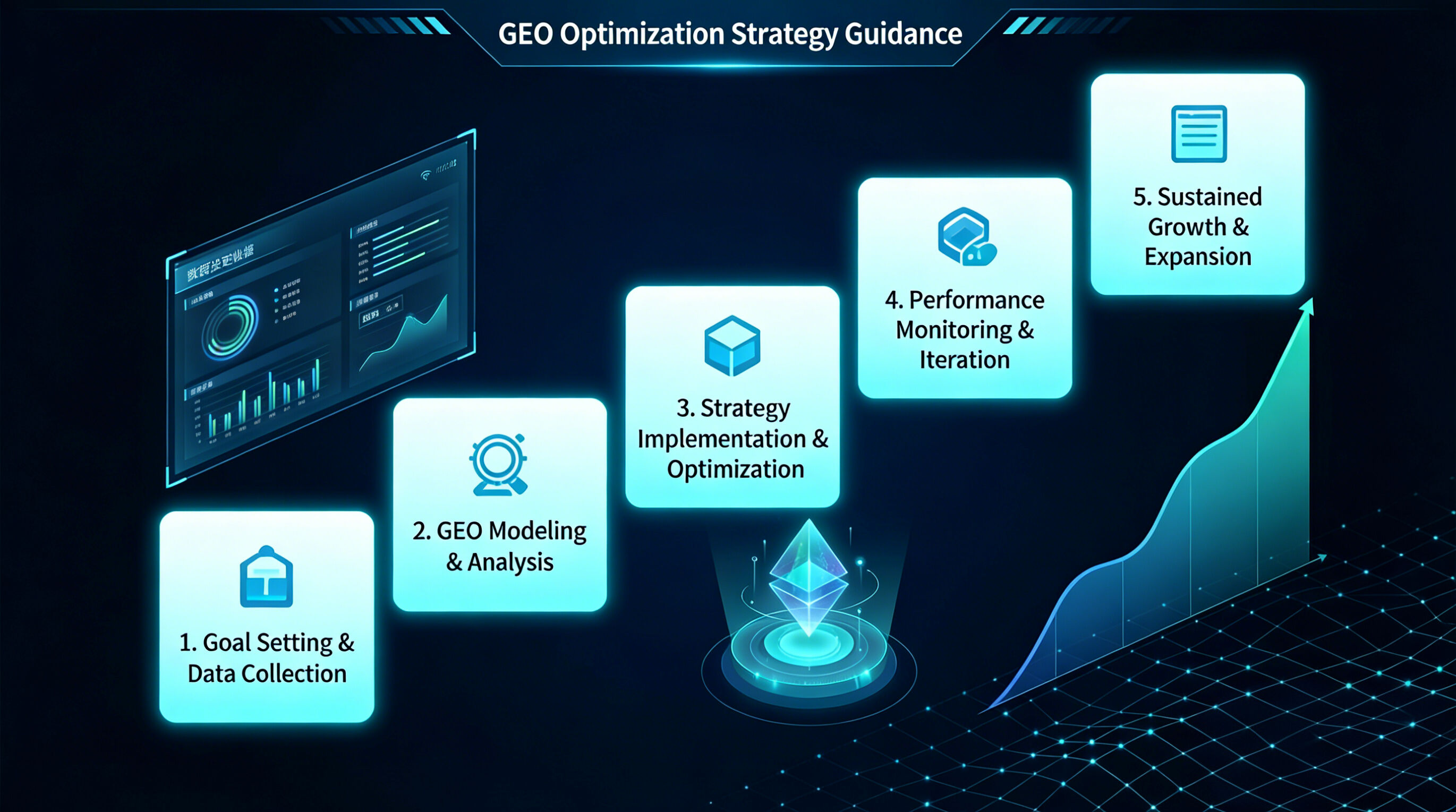
GEO optimization is not a one-time event, but a continuous operational process. After content publication, it is necessary to continuously track key metrics: the frequency of content appearance in mainstream AI tools, the precise traffic brought by AI search, core content fragments cited by AI, and the AI citation status of competitor content. Meanwhile, to meet the timeliness requirements of AI search, core content must be reviewed and updated quarterly, outdated information must be promptly marked and replaced, and data and case studies must be continuously iterated to ensure that content maintains high credibility and high citation priority within the AI system.
IV. Core Trends and Business Opportunities for GEO Optimization in 2026
As the penetration rate of AI search continues to increase, GEO optimization is transforming from an option to a strategic necessity for enterprises. Google data shows that in Q4 2025, Google AI Overviews coverage in the US market reached 65%, and this figure is expected to exceed 85% by the end of 2026; Perplexity has surpassed 50 million users, with daily queries reaching 120 million. Companies that neglect AI search optimization will continue to lose brand visibility and user awareness in 2026. Meanwhile, the industry is showing three clear trends: First, brand optimization is becoming core. AI systems tend to reference brands that appear frequently in training data and have consistent brand perception. Consistent brand expression across all channels directly determines the probability of AI referencing. Second, real-time content is becoming a core competitive advantage. AI systems prioritize real-time updated content, and automated content update mechanisms will become a core competitive advantage for enterprises. Third, multimodal content is on the rise. Multimodal content, including charts, images, and videos, has a 73% higher AI referencing rate than plain text content and is more easily recognized and extracted by AI systems.
V. BMS DXP: Building an Integrated SEO+GEO Search Marketing Ecosystem
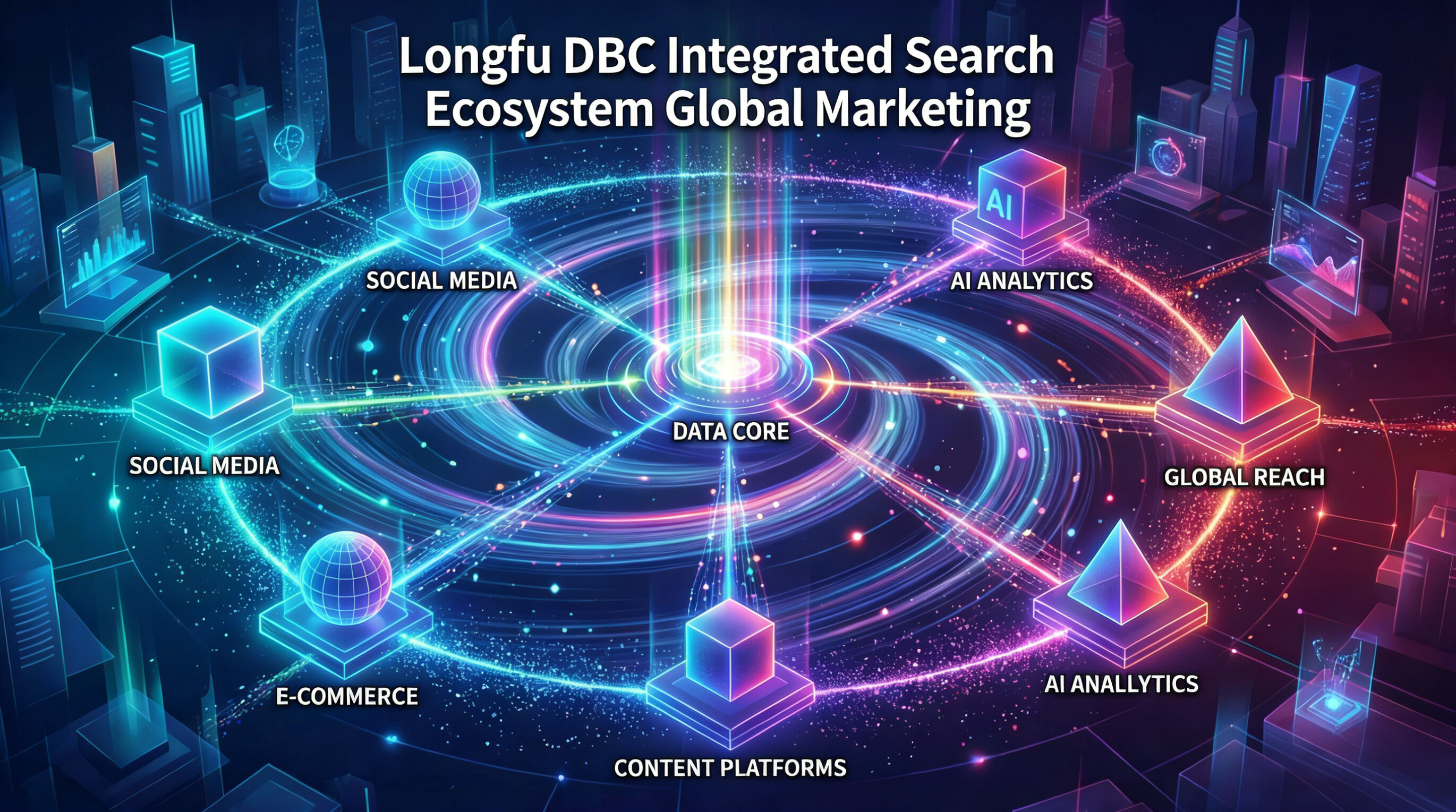
In the AI search era, enterprises no longer need a single SEO service, but rather an integrated marketing system that can adapt to both traditional and AI search.BMS DXP is deeply involved in the field of enterprise digital transformation, focusing on consulting, optimization, and technology to create a full-link search marketing ecosystem that integrates SEO, SEM, and GEO, achieving full visibility coverage for brands in both traditional and AI search.
Leveraging the BMS DXP digital experience platform, BMS DXP builds brand content infrastructure for enterprises adapted to the AI era: Through a multi-channel content management system, it achieves structured content creation and synchronized information across all channels, ensuring consistent brand expression and providing stable and reliable cognitive input for AI systems; through a digital asset management system, it accumulates verifiable and authoritative assets such as customer case studies and data reports, strengthening the brand's professionalism and credibility within the AI ecosystem; and through an integrated e-commerce engine, it deeply integrates structured product information with professional service content, accurately matching user decision-making scenarios in AI search, helping enterprises achieve a closed-loop process from awareness to conversion.
From automotive, finance, and consumer electronics to cross-border e-commerce, BMS DXP has provided full-cycle digital solutions for leading enterprises across multiple industries. With a dual-driven model of products and services, it helps enterprises build an irreplaceable cognitive moat in the AI era, achieving high-quality, sustainable growth.
SEO/GEO Service Capability Comparison Table
| Comparison Dimensions | Traditional SEO Service Providers | General AI Content Tools | BMS DXP Integrated SEO/GEO Solution |
| Core Logic | Keyword matching and external link building, only adaptable to traditional search | Pure content generation without search ecosystem adaptation capability | Dual-engine adaptation of SEO + GEO, covering all scenarios of traditional + AI search |
| Content Capability | Focus on keyword layout with insufficient structuring and entity density | Generalized content lacking verifiable data and industry depth | Structured content creation + authoritative asset accumulation, in line with AI search citation standards |
| Technical Support | Single SEO technical tools without a full-link system | No enterprise-level content management and omni-channel distribution capabilities | Supported by BMS DXP platform, forming a full-link closed loop of content + assets + e-commerce |
| Long-term Value | Short-term traffic improvement without cognitive barriers in the AI era | One-time content output without long-term operation capabilities | Construct brand content infrastructure in the AI era and form a long-term cognitive moat |
Frequently Asked Questions (FAQ)
Q1: GEO optimization and traditional... What are the core differences between SEO and traditional SEO?
Traditional SEO focuses on "keyword matching," improving rankings on traditional search engines through keyword placement, backlink building, and technical optimization. Its core goal is to acquire clicks and traffic. Generative Engine Optimization (GEO), on the other hand, focuses on "reference value." By optimizing content's entity density, structure, and data credibility, it prioritizes content for AI systems to recognize, reference, and recommend. Its core goal is to capture the user's AI cognitive entry point and enter the initial recommendation list for user decision-making.
Q2: Which types of companies need to prioritize GEO optimization?
Companies with high average order values, long decision-making cycles, and user decisions reliant on pre-market research need to prioritize GEO optimization. This includes B2B SaaS and enterprise services, cross-border e-commerce, high-end manufacturing, professional services, and local life services. These users have fully shifted their information acquisition channels to AI search. If a brand cannot be prioritized by AI, it will directly lose a significant number of potential business opportunities.
Q3: What core pain points can BMS DXP's integrated SEO/GEO solution address for businesses?
BMS DXP's integrated solution addresses three core pain points for enterprises in the AI era: First, the continued decline in traditional SEO effectiveness and the visibility crisis caused by content becoming completely "invisible" in AI search; second, fragmented and inconsistent brand content, preventing AI systems from forming stable and credible brand perception; and third, the disconnect between content creation and business conversion, hindering the closed loop from AI recognition to business growth. We help enterprises build AI-optimized brand content infrastructure through an integrated service encompassing technology platform, strategy consulting, and full-cycle operations, achieving a dual improvement in overall visibility and business growth.
Q4: How long does it take for enterprises to see tangible results from GEO optimization?
GEO optimization is a long-term process of building brand digital assets, not a short-term traffic injection. Typically, after completing the structured optimization of its content system and establishing authoritative sources, enterprises can build stable brand awareness in the AI system within about 3 months. The results are reflected in increased AI mention frequency and increased precise traffic from AI searches. With continuous operation for more than 6 months, a cognitive moat within the AI ecosystem can be gradually built, achieving continuous conversion of high-quality business opportunities.
Q5: Which industries' enterprise needs can Longfu BMS DXP solutions meet?
BMS DXP has service experience in multiple industries including automotive, finance, consumer electronics, healthcare, cross-border e-commerce, manufacturing, and education. Based on mature modular solutions and deep industry insights, it can customize and adapt SEO/GEO integrated strategies for the AI search characteristics of different industries, while also supporting the needs of multilingual and multi-regional global business layouts.


Want to know more about our products?
With years serving Fortune 500 clients, we offer flexible solutions and integrated implementation.
